

“Local News by Local Citizens”




Tax Millage Increase on the Horizon By Matt Sharpe
At the Upson County Board of Commissioners recent meeting, Chairman Rusty Blackston addressed those in attendance and said that there would more than likely be a tax millage increase this year.
“I’ll just be honest with you,” said Chairman Blackston. “Our revenues are down in the county, due to re-evaluation of property. I’ll go ahead and give you a heads up. There is probably going to be somewhat of a millage increase this year. Our revenues are down. Our property values are down 15-20 percent, and when they drop that much, so does the taxation revenue. We’re going to try to cut everything and hold it as tight as we can, but just to give you a heads up, it’s probably going to happen. I for one don’t like it, but we’re going to do everything we can to hold it within bounds.”
The BOC held a work session July 16 to discuss many matters regarding the budget. The meeting was not available for this week’s edition but will be in next week’s edition of The Upson Beacon.
In 2011, property owners in Upson saw a one-time millage rate rollback. The rollback stemmed from left over funds from the 2005 SPLOST. Several projects never got off the ground and the money that would have been used for the projects was given back to the taxpayers in the form of a millage rollback. Last’s year’s millage rate was increased before it was rolled back.
Commissioner Steve Hudson stated that after looking at options for paving the seven roads that are to be paved under the 20111 SPLOST, the numbers being brought in by the 2011 Special Purpose Local Option Sales Tax (SPLOST) are down from what was originally anticipated. The 2011 SPLOST that passed was a five year, $16 million dollar SPLOST.
“Part of the reason is because the State of Georgia passed a law that says manufacturers don’t pay any sales tax on utilities anymore,” said Commissioner Hudson. “Since the first of the year, it looks like we are averaging around $220,000 a month. If that continues, we’re not going to meet our $16 million. We’re going to be about $14 million. So that means we’re going to have to start looking at some projects and scaling them back, or doing something with them.”
EMS Director Richard Lee addressed the BOC that night and presented the board with stats from the second quarter. He stated that the month of June was the busiest month of June for the EMS in five years. He noted that usually in June and July the EMS drops off drastically because everyone leaves town. The EMS has received a total of 3005 calls since January.
County Manager stated that six applications had been received from interested citizens wanting to serve on the Recreation Advisory Committee. He added that a few more applications were received the day of the meeting.
Three bids have been received to repave Atwater Road. The lowest bid was $366,000. Seven Roads are to be under the 2011 SPLOST.
Murphy Represents Thomaston in National Motocross Championships
Foot Chase Leads to Arrest
New Recreation Advisory Committee Being Tossed Around by BOC
The creation of a new Recreation Advisory Committee was tossed around by the Upson County Board of Commissioners at their meeting held June 25. After much discussion the BOC approved, by a 5-0 vote, to establish the new committee. The announcement was made at the BOC’s meeting held at the Government Complex.
According to BOC Chairman Rusty Blackston, the Recreation Department does not have a recreation board in place. He said that a lot of questions are being asked by the public to the BOC about what can be done to make the recreation department and leagues better.
“We have a lot of complaints here that children are leaving and going to Pike County to play ball,” Blackston said. “I would like to see this board establish a Recreation Advisory Committee which would have no powers as far as purchasing, no supervisory powers, or anything of that nature. This would plainly be the eyes and ears on the ground in our recreation facilities to bring back to us, because I don’t have time and I don’t know much about it (in regards to recreation).
Blackston recommended the board to consist of five to seven individuals to be the “eyes and ears to watch the recreation department”. The committee would bring ideas for improvement to the board on any problems that may arise and also in turn help the BOC address the problems to the recreation department.
“If we have this committee and they bring us ideas, we really need to look at them closely and the good ideas we need to use,” said Commissioner Frank Spraggins. “In the past, ideas have been given to us and we just didn’t do anything about it. I think, right now, that is some of the problems we are having…that over the years we dropped the ball.
Commissioner Ralph Ellington said, “We need to pursue some avenue, because we are all getting complaints about the recreation and availability here in the county. At one time we had one of the best recreation departments in the southeast. I feel like a lot of requests have been made in the past and they have fallen on deaf ears and that’s one of the reasons it’s gotten to the shape it is in now.”
A motion was made by Commissioner Spraggins for the establishment of the committee and a second was made by Commissioner Ellington. The vote passed 5-0.
Members of the committee will not be a paid as the position is strictly a volunteer position. Applications to be a member of the committee are being accepted. Contact the County Managers office for more information on applying for the committee.
In other business, the BOC approved a recommendation from the Water Department supervisor to lower the commercial deposit fees on water system. Rates for deposits were at $500 and have now been lowered to $250. The rate for deposits will remain the same as they have been, at $100. The action was passed with a 5-0 vote.
The discussion of the abandonment for a portion of Searcy Road was made at the BOC’s meeting but tabled so that more information on the situation could be made. The discussion was that roughly 1041 feet of the road would remain being taken care of by the county and the rest of the road being used by a timber company would be abandoned. The problem arose when County Attorney Ed Trice told Chairman Blackston that the road hasn’t been on the county road made in over 24 years and isn’t considered an official county road. The discussion of abandoning a portion of the road was tabled by the BOC.
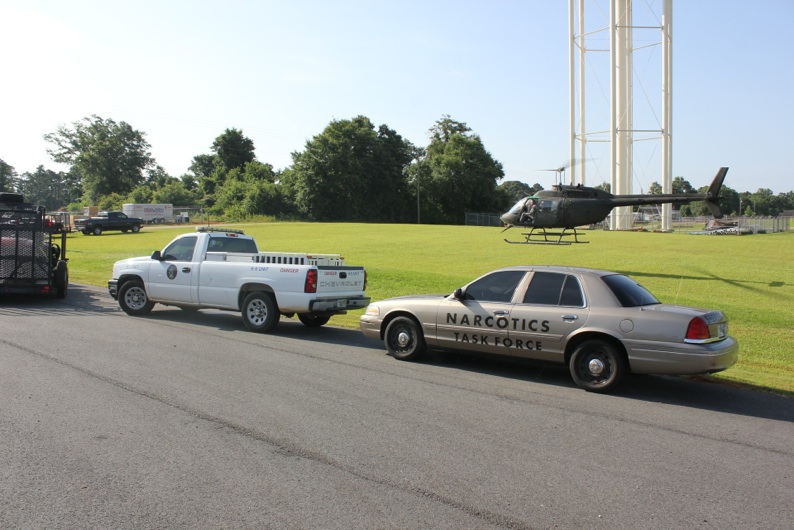
Drug Helicopters Grid Search Upson
If you saw a blue and grey or green helicopter circling over your house June 25 and you didn’t get a knock on the door, then you didn’t have illegal drugs on your property.
That day, two helicopters were searching Upson County as part of the Governor’s Task Force Drug Suppression program to crack down on illegal drugs. The Upson County Sheriff’s Office, Narcotics Task Force, Georgia State Patrol, Department of Corrections and the D.N.R. assisted in the fly over.
Using intelligence gained from the local NTF, the helicopter pilots grid searched looking for marijuana plants that are illegally planted. They first worked off coordinates from the Intel and then freelanced over the county searching for plants.
The members of the team are trained to spot the plants from 500 feet above the ground. The process is to locate, confirm and eradicate. Members of the team said that the plants are very noticeable from the air and basically “stick out like a sore thumb” due to the bright green color they have.
The plants need a certain amount of water and sunlight to grow, so there are certain parts of each county that the team freelance over looking for plants, including the banks of the Flint River. According to members of the team, the river provides a great water source for those trying to grow the plants.
If a plant or plants are spotted from the air, a call is made to members of the team on the ground and the GPS coordinates are relayed to them. From there, the team is guided to the area by the helicopters. After the plants are located, they are removed and a search for the rightful owner of the plants is performed. Any plants that are found are later destroyed by the county.
According to the D.E.A., marijuana is also one of the most popularly used and abused drugs in the U.S., and a lot of plants are grown in Georgia.
All 159 counties in Georgia are flown at least once a year. It takes roughly one day to fly over a county the size of Upson. The expenses for the flyovers are paid through money and assets seized through the D.E.A. The only expense that the flyovers have is through the salaries of the members of the team.
According to Sheriff Dan Kilgore, no illegal marijuana plants were found during the search of the county.



The phrase “the apple doesn’t fall far from the tree” could not be more fitting for one father/son duo in Thomaston. Chad Murphy has long been competing on the AMA Amateur Motocross circuit, and has instilled these same skills in his six-year-old son, Caden.
Caden recently punched his ticket to Amateur Motocross’ premier annual event, the Red Bull AMA Championships at Loretta Lynn’s Ranch.
The Red Bull Amateur National Motocross Championship has nearly 20,000 riders annually attempt to qualify in 36 classes for the 1,446 available positions at the Amateur National at Loretta’s.
Caden will be competing in the Yamaha PW 50 class, which includes just 30 riders from across the country.
The event has served as a launch pad for several of the world’s most talented motocross riders, including James Stewart, Ricky Carmichael, Travis Pastrana, and Jeremy McGrath, who have all earned AMA Amateur National Championships at Loretta Lynn’s. Names such as Ryan Villopoto and Ryan Dungey have competed in years past as well.
The race was added to the Red Bull Signature Series just last year, earning coverage on NBC for the first time in its history. This year’s event will enjoy its first year of live coverage from NBC. Potential viewers can tune in on Saturday, Aug. 3, at 3 p.m. and maybe catch a glimpse of Caden in competition.
A student of Upson-Lee South Elementary, Caden picked up his first dirt bike at the age of two years old and has not let up since. He enjoys sponsorships from Capitol Cycle in Macon, FCR Suspension South, Hazardous MX, and his parents, Chad and Leslie Murphy.
Caden does most of his training with his father and professional rider Andrew Matusek, of Hazardous MX, on a track located right behind the Murphy’s home in Thomaston.
He competes nearly every weekend at tracks located throughout the southeast, and has spent the last four months competing for a chance to race in the championships at Loretta Lynn’s.
In order to qualify for the event, one must come out on top in area and regional qualifiers throughout the year. There are several classes ranging from minicycle classes for children four years of age, to the senior division for riders over age 50.
Caden’s father, Chad, will also be competing in this year’s event for the fourth time in his career. The race runs from July 29-Aug. 3, 2013.
Caden Murphy hoists two of his awards after a training session last week
Thomaston’s Caden Murphy makes his way around the practice track during training for the Amateur National Motocross Championships

A foot chase between TPD officers and an alledged drug dealer broke out on Third Street in Thomaston on July 8 around 11:45 a.m. In the end, the police won and a 22-year-old was arrested for possession of marijuana.
Jamal Daniel Matthews, age 22 of Roberta, Ga., was arrested and charged with one count of possession/manufacturing/distribution of a controlled substance and one count of abandonment of certain dangerous drugs.
According to the report from Thomaston Police Department Investigator Phillip Tobin, while in the area of Third Street and Avenue K, a black male identified as Matthews was spotted walking north on Third Street toward the officer’s vehicle that was traveling south. As Matthews realized that he was walking towards the officer’s vehicle he looked at Inv. Tobin and pulled his hat down and then cut through a yard on Third Street. Sgt. Ledbetter was notified of the situation and Matthews’ actions. Inv. Tobin then gave chase as he cut through several yards and called out several times for Matthews to stop but he still ran. Matthews was finally tackled in the back yard of a residence on Third Street.
During the time Matthews was running from officers, he was observed holding his pants up and throwing down two clear plastic bags of marijuana. Two smaller plastic bags of marijuana were found inside the two larger bags.
Matthews was secured without further incident and the marijuana was recovered and photographed for evidence along other small zip lock bags found on the assailant and $230 in cash.
TPD officer Bobby Ellington assisted in the arrest and aided in helping the suspect pull up his pants.
TPD Officer Bobby Ellington is pictured taking the suspect into custody


THE 2013 BOOBIE BALL WILL BE HELD SATURDAY, SEPT. 14 AT BICKLEY’S LAKE. GATES WILL OPEN AT 4 P.M. DANCE THE NIGHT AWAY WITH LOOSE CHANGE AND FRIENDS! CORNHOLE TOURNAMENT-BOAT RIDES-BIG SCREEN TV TO WATCH THE GAMES-DUNKING BOOTH-T-SHIRTS-$20 DRAFT ALL YOU CAN DRINK. SEVERAL GREAT PRIZES WILL BE UP FOR RAFFLE INCLUDING A LG 60 INCH HDTV FROM BADCOCK AND MORE HOME FURNITURE- JUDGE PUBLIC DEFENDER REVOLVER FROM NORTHSIDE PAWN SHOP- HUSTLER RAPTOR ZERO TURN LAWN MOWER AND YETI YT 20 ROADIE COOLER FROM THOMASTON HARDWARE- TWO $250 WAL-MART GIFT CARDS- DIAMONDS FROM REEMS JEWELRY. 2013 RAFFLE TICKETS ARE ONE FOR $5 OR FIVE FOR $20. TICKETS TO THE BOOBIE BALL ARE $12 IN ADVANCE OR $15 AT THE GATE. TICKETS GO ON SALE AUG. 1 AND CAN BE PURCHASED AT THE UPSON BEACON. COOLERS ARE WELCOME (NO GLASS PLEASE).



